
10 years on from Brexit
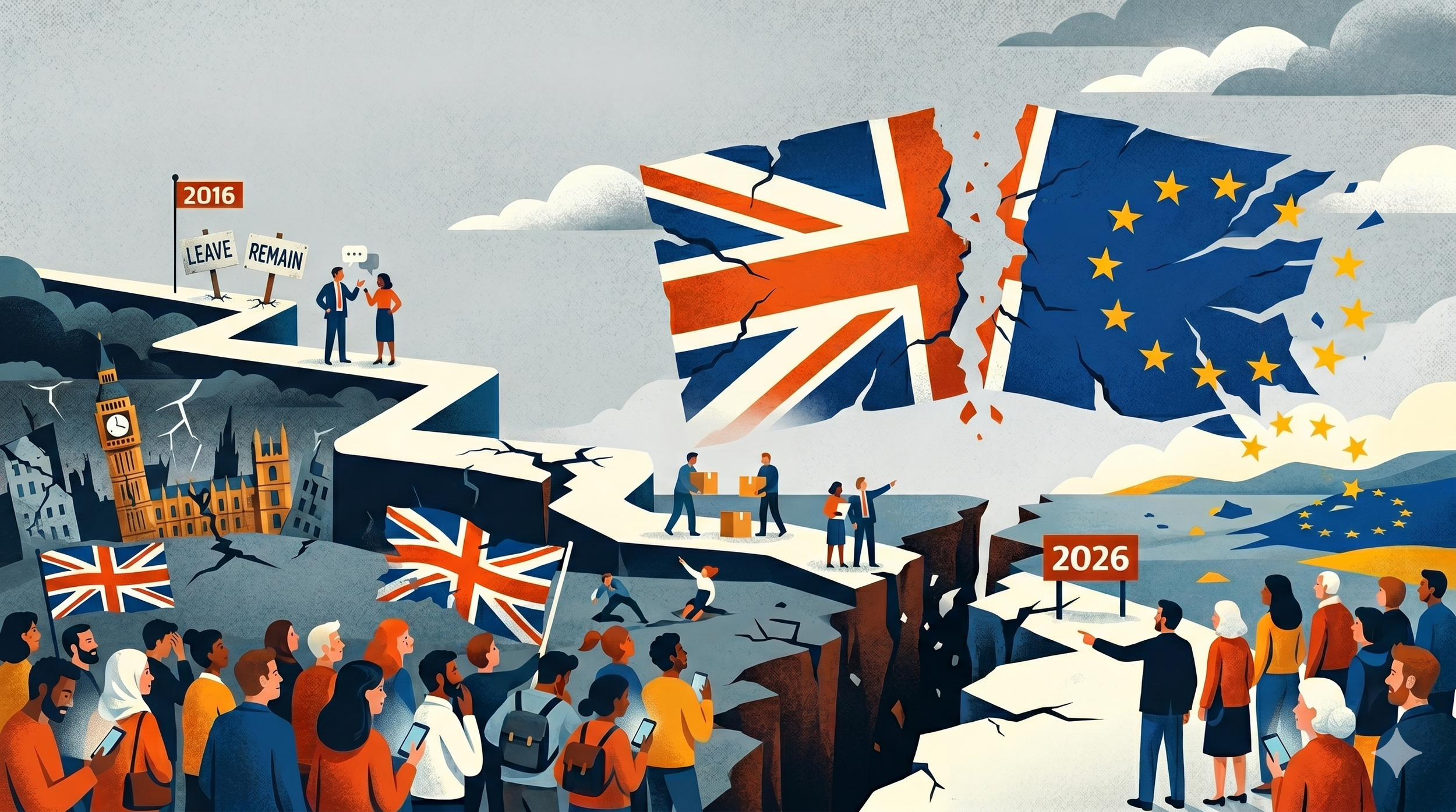
10 years on from its vote for Brexit, the UK is a poorer, angrier, less stable and more divided country
It’s now a decade since the UK voted to leave the European Union. For some reason, I’ve kept the newspapers from that day, 10 years ago, when that decision was made.
One thing that’s happened in the years since is the information inside newspapers (serious ones, at least) has become a lot less important. Nonetheless, I thought it would be worth a look at what proper reporting says about the state of affairs, 10 years on from Brexit.
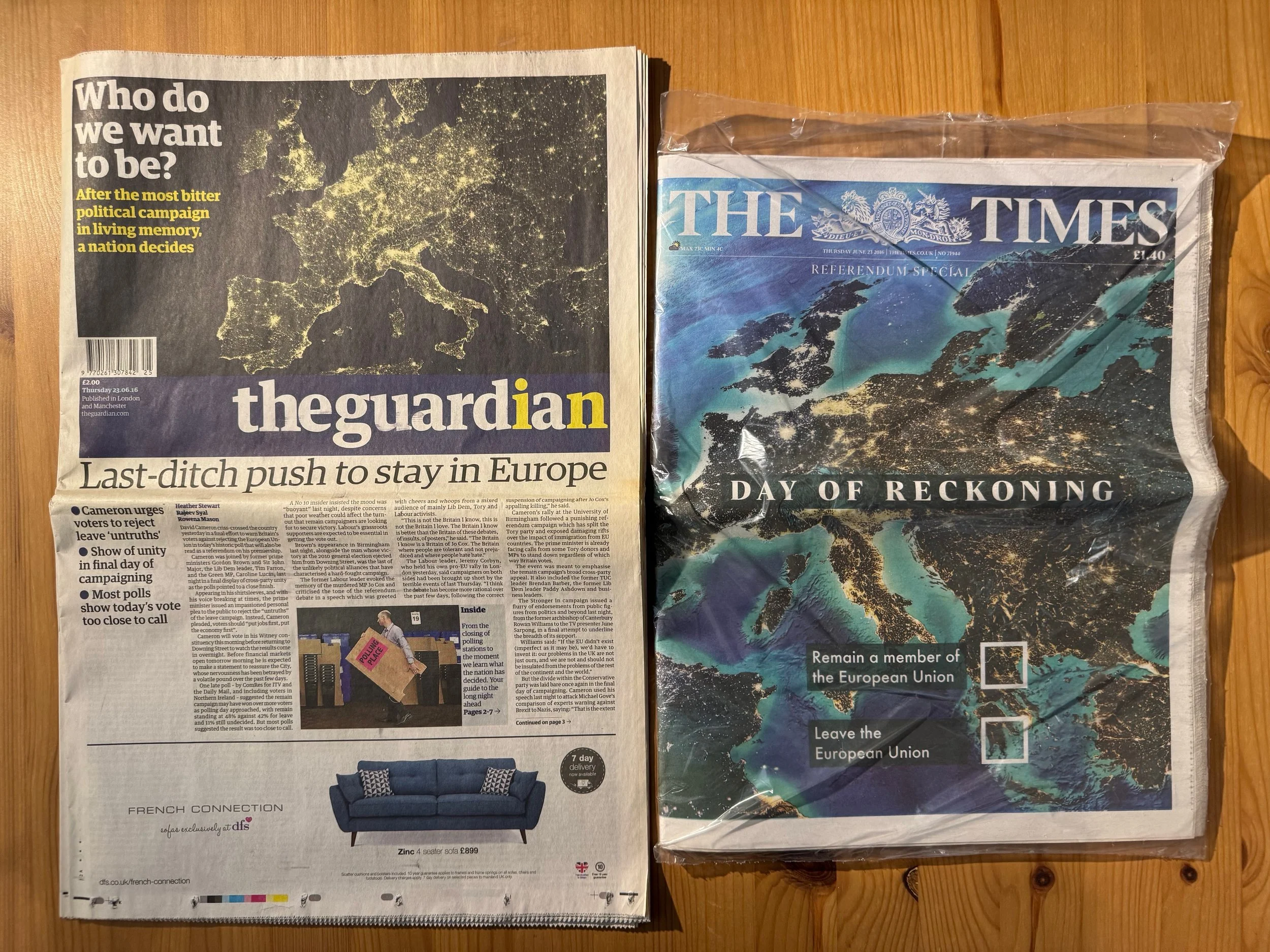
Copies of The Guardian and The Times from 23 June 2016, preserved – as if in amber – at the bottom of my bookshelf.
Economy
During the referendum, Remainers were accused of perpetrating a “Project Fear” with their warnings of the negative effect Brexit would have on the UK’s economy. When Britain didn’t plunge into recession immediately after the vote 10 years ago, this was claimed as a vindication.
But it would take a further four years for the UK’s exit from the EU to actually be enacted, after which the world was almost immediately plunged into economic paralysis by the COVID-19 pandemic, making counterfactual analysis difficult.
Nevertheless, as The New York Times reports, economists broadly agree the UK’s economy is between 4–6% smaller than had it stayed within the EU, with one widely cited study, led by Stanford professor Nicholas Bloom, finding the impact could be as high as 8%.
In more practical terms, a Cambridge Econometrics report found the UK now has nearly 2 million fewer jobs due to Brexit, and it estimates the average Briton is almost £2,000 a year worse off.
Trade
Some proponents argued a smaller post-Brexit economy would actually be preferable as it would be a better type of economy – with more control over trade and industrial policy, a ‘Global Britain’ economy would comprise a greater share of manufacturing and goods exports by trading more with the wider world beyond Europe.
Well, in 2016 manufacturing accounted for 9% of the UK economy, while a decade later it accounts for 8.9%. As for trading with the rest of the world – despite signing 39 trade deals with 72 countries, the EU is still by far the UK’s largest trading partner, accounting for 40% of all our trade, albeit a slightly lower proportion than before the referendum. But goods exports outside of the EU have not increased to compensate – instead, as CNBC reports, they’ve shrunk by 8% since Brexit came into effect.
A decade on, the UK is actually more dependent on services trade than it was before Brexit.
Currency
And that’s despite sterling taking a pounding. The currency is down between 10–11% against the dollar and euro. Before the referendum, £1 would fetch you $1.40 and it’s not once been that high since – today it’ll nab you $1.32, having been as low as $1.12.
A weaker currency is typically beneficial to exports as goods become cheaper to foreign pockets, but this effect has not been enough to overcome greater post-Brexit trade barriers for UK exports.
And the other side of that coin is a weaker currency reduces the purchasing power of the people who hold it, which contributes to…
Inflation
Following the pandemic, there was a worldwide surge in inflation, however the UK has fared worse than most in the decade since the referendum. Reuters reports that, since 2016, consumer prices in the UK have risen 41.4% as of last month, the second-highest rise in Western Europe (after Austria).
There is no let up on the horizon either, as BBC News reports, last year the UK had the highest inflation in the G7, and it’s still above the Bank of England target.
Assets
Inflation eats away at savings, which is why savers look to non-cash assets to get a return and maintain the real-term value of their money. However, the decade since Brexit has made the UK challenging terrain for investors.
Gilts – bonds issued by the UK government – have been more volatile than the sovereign debt of other G7 countries, having lost their “safe haven” status.
The picture for stocks looks rosier at first, with the FTSE 100 having recently hit record highs and the index seeing a 66% rise over the last decade. However, this lags significantly behind its equivalent indices in France (105%), Germany (169%) and US (258%) over the same period. Worse still, the more domestically oriented FTSE 250 has actually lost 2% of its value in real terms since the Brexit vote, compared to 13% and 19% gains for its equivalent in France and Germany, respectively.
Immigration
Given that 60% of Leave voters said “significant damage” to the UK economy was a “price worth paying for bringing Britain out of the EU”, it’s possible then that lower GDP, fewer jobs, less trade, a weaker pound, higher prices, and poorer investment returns would all be worthwhile for Brexit supporters, provided it meant ‘taking back control’ of the border.
When David Cameron first promised an in/out referendum on EU membership in January 2013, just 22% of Britons said immigration was an important issue facing the country. By the eve of the referendum, that figure more than doubled to 48%. 10 years later, the figure is still 41%.
Many Brexiteers swore they were not against immigration, and instead wanted to leave the EU to stop its “discriminatory” border policy, allowing more fair immigration from outside of the EU. Priti Patel even said this would “save our curry houses”.
This would all be enabled by Vote Leave’s proposed “points-based immigration system”. The Remain campaign warned this would actually lead to higher immigration, but this was dismissed by, who else other than Nigel Farage.
This ‘less discriminatory’ system was implemented, and EU migration did indeed decrease, with net figures going into reverse. But migration from outside of the EU sky-rocketed, with net figures surpassing +1 million in 2023. This was what Brexiteers wanted though, right?
Well, Nigel Farage (who supported the implementation of the current points-based system, remember?) and his party (which began life as the Brexit Party), is leading in the polls.
People will disagree whether Reform is a far-right party, but Restore Britain certainly is. Rupert Lowe’s party just received almost 7% of the vote in the Makerfield by-election, the highest for a far-right party since 2012 when the BNP got 8.5% in the Rotherham by-election.
And after three consecutive summers of race riots, it’s clear the far-right is rising in both the streets and the sheets (in the ballot box).
Public opinion
Just after Brexit came into effect, 37% of British adults said the country was heading in the right direction, compared to 43% who said it was heading in the wrong direction: a -6% net figure.
Last month, that dropped to -55%, with only 13% saying the right direction, compared to 68% saying the wrong direction. Few can see “sunlit meadows” over the hills ahead.
Political stability
Instead, Britain is in a long ‘Age of Discontent’ that makes governing the country a seemingly impossible challenge.
As if to illustrate this with almost perfect timing, Sir Keir Starmer yesterday announced he would stand down as prime minister. He stood on the steps of Downing Street just two days shy of a full decade after David Cameron made the same announcement, the morning after his colossal referendum gamble failed catastrophically.
It now looks an inevitability that Andy Burnham will become the country’s seventh PM since Cameron pledged the EU vote in a bid to earn himself a stable majority. Like a Greek tragedy, it ended Cameron’s career and bequeathed a decade of national instability in his wake.
No 10’s latest tenant now faces the same implacable inheritance of his five post-Brexit predecessors – exacerbated in degree, and constrained in remedy, by Britain’s exit from the EU.
10 years on from its vote for Brexit, the UK is a poorer, angrier, less stable and more divided country.
Time for a rethink. ⬢